How Much Does It Cost to Run a Website Per Year?
Once a site is live, the cost to run a website per year is a completely separate question from what it cost to build. A personal blog can run on $60 to $1,200 a year. A small business site typically lands between $600 and $6,000. An online store can climb into the thousands per month once payment processing and support are added in. The build price is a one-time number; the running cost never stops.
Below, we break down exactly what makes up a website’s annual running cost, realistic totals by site type, and practical ways to keep that number down without cutting corners on security. If you’re still budgeting for the initial build, our guide on how much it costs to build a website covers that separately. You’ll also find answers to the questions people ask most about ongoing website costs.
Every Line Item in a Website’s Annual Running Cost
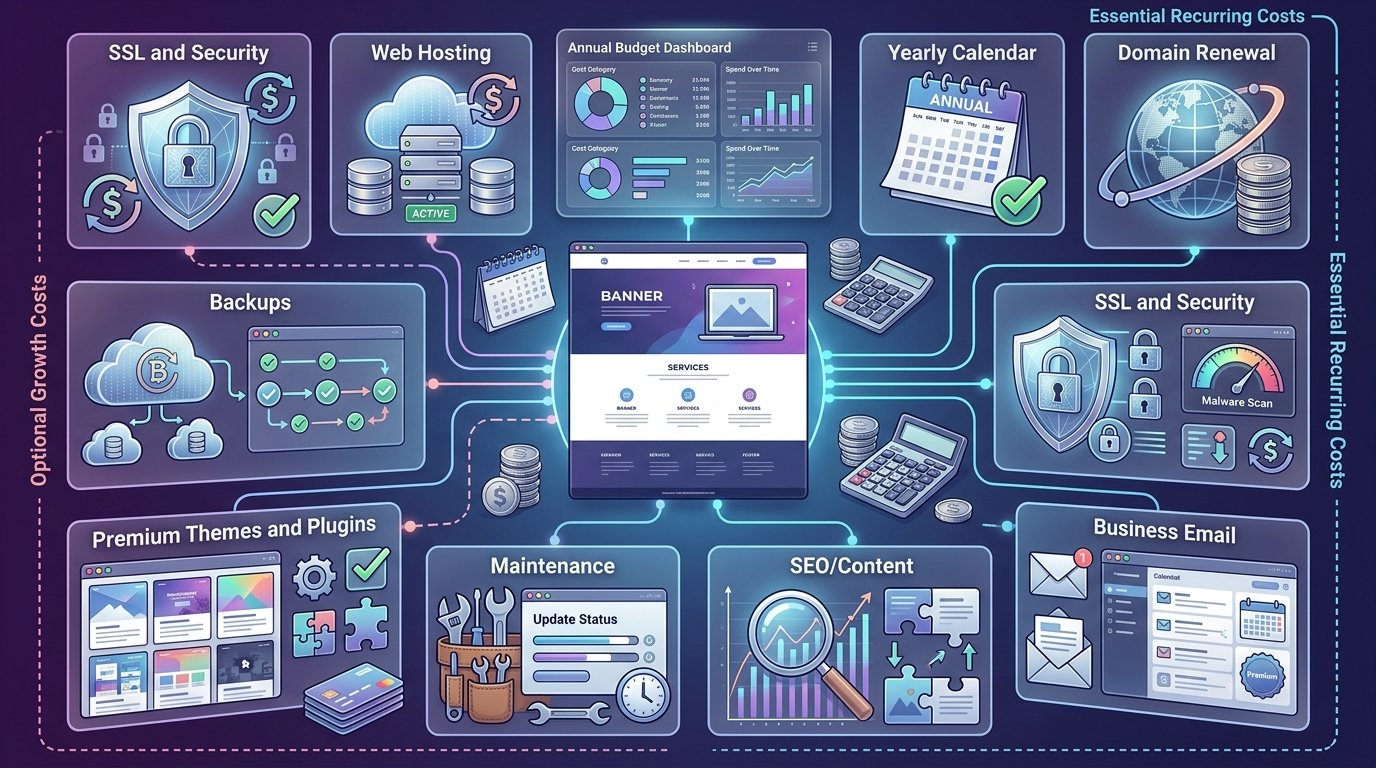
Regardless of site type, most of the recurring bill comes from the same handful of categories:
- Domain renewal: $10–$20/year for a standard extension, more for specialty ones like .io or .store, which can run into the hundreds.
- Hosting: $2–$15/month for shared hosting, $20–$150+/month for managed or higher-tier plans depending on traffic and features.
- SSL certificate: Usually free with modern hosting, or $8–$60/year if purchased separately for extra features.
- Domain privacy protection: Often free, sometimes a small added fee, hiding your personal contact details from public WHOIS records.
- Plugins and themes: Free options cover most needs, but premium versions typically renew at $50–$200/year each.
- Maintenance and updates: $0 if you handle it yourself, $50–$300/month for a professional maintenance plan.
- Backups and security monitoring: Frequently bundled into hosting, or $100–$200/year as a standalone plugin or service.
Realistic Annual Running Costs by Site Type
| Site Type | Typical Annual Cost | What Drives It |
|---|---|---|
| Personal blog | $60–$1,200 | Domain, basic hosting, minimal plugins |
| Small business site | $600–$6,000 | Managed hosting, some paid plugins, content updates |
| Online store | $2,400–$18,000+ | Payment processing, higher-tier hosting, more support |
| High-traffic or enterprise site | $6,000–$50,000+ | Dedicated infrastructure, dedicated support team |
Figures reflect typical 2026 industry ranges and vary based on platform, traffic, and how much support you pay for versus handle yourself.

DIY Maintenance vs Paying for It
The single biggest swing factor in your annual total is whether you maintain the site yourself or pay someone else to. Doing your own updates, backups, and basic security checks costs nothing beyond your time, and for a simple site, that time investment is genuinely small once you’re past the initial setup. Professional maintenance plans, by contrast, typically run $95 to $195 a month for a small business site, or considerably more for anything complex.
A reasonable rule of thumb from across the industry: budget 10 to 15% of your initial build cost for annual maintenance, whichever route you take. If your site cost $2,000 to build, that puts a realistic yearly maintenance budget somewhere around $200 to $300, whether that’s your own time or a paid plan. GoDaddy’s website maintenance checklist is a useful outside reference for what regular upkeep actually involves.
How to Keep Your Running Costs Down
- Bundle your domain with hosting. Many hosts include a free domain for the first year, and keeping both under one account simplifies renewals.
- Stick with free SSL. It provides the same core encryption as paid options for the vast majority of sites, with no added yearly cost.
- Audit your plugins yearly. Unused premium plugins are a quiet, recurring expense that’s easy to forget about until renewal.
- Do basic maintenance yourself if you’re able. Updates and backups are often the largest recurring line item, and many are simple enough to handle without a paid plan.
- Choose a host with backups and security included. Bundling these into your hosting plan avoids paying for a separate standalone service.
Keeping the Core Costs Low With the Right Host
Since hosting and domain renewal are the two costs every website carries no matter what, choosing a provider that bundles both efficiently makes a real difference over several years. Hostinger’s Premium plan, starting around $2.69/month on a long-term commitment, includes a free domain for the first year and free SSL, covering two of the recurring line items above without a separate purchase.
A few features that help control the ongoing total specifically:
- Daily backups included from the Business plan up, avoiding a separate backup subscription.
- Free malware scanning and a web application firewall on higher-tier plans.
- 24/7 support included in the plan price, rather than billed as a separate maintenance retainer.
- A clear upgrade path if your traffic grows, so you’re not overpaying for capacity you don’t need yet.
People Also Ask
How much does it cost to run a website per year?
A personal blog typically costs $60 to $1,200 a year to run, a small business site $600 to $6,000, and an online store considerably more once payment processing and support are factored in. Hosting, domain renewal, and maintenance make up most of the total.
What’s the difference between building a website and running one?
Building is a one-time cost covering design, development, and initial setup. Running a website is the ongoing annual cost of hosting, domain renewal, security, and maintenance, which continues for as long as the site stays live.
Do I have to pay for website maintenance every year?
Not necessarily, if you’re comfortable handling basic updates and backups yourself. Many small sites run for years on nothing more than hosting and domain renewal, with maintenance costs only becoming significant if you pay a professional to handle it.
Why do online stores cost more to run than a blog?
Ecommerce sites carry extra recurring costs a blog doesn’t: payment gateway fees, higher-tier hosting to handle checkout traffic reliably, and often more frequent security monitoring given the sensitive customer data involved.
How can I lower my website’s annual running cost?
Bundle your domain and hosting with one provider, stick with free SSL, audit unused premium plugins yearly, and handle basic maintenance yourself where you’re able. Choosing a host that includes backups and security in the plan price also avoids paying for those separately.
Final Takeaway
The cost to run a website per year varies enormously by site type, but the core expenses, hosting, domain renewal, SSL, and maintenance, stay largely the same categories whether you’re running a blog or an online store. A personal site can realistically run under $200 a year on the right host, while a small business site should budget for a few hundred to a few thousand depending on how much support you pay for. Starting with a host like Hostinger that bundles the recurring essentials, domain, SSL, and backups, keeps that annual number predictable from year one.