Shared Hosting vs VPS Hosting: Which Do You Need?
The shared hosting vs VPS hosting decision usually comes down to one question: do you need more control and consistency than a shared plan can give you? Both can run WordPress, WooCommerce, or a custom application just fine. The real difference is how much say you have over the server, and how predictable performance stays when things get busy.
Below, we explain how each option actually works, compare them on price, performance, and control, and help you figure out exactly when it’s time to upgrade. You’ll also find a comparison table and answers to the questions people ask most when choosing between the two.
What Is Shared Hosting?
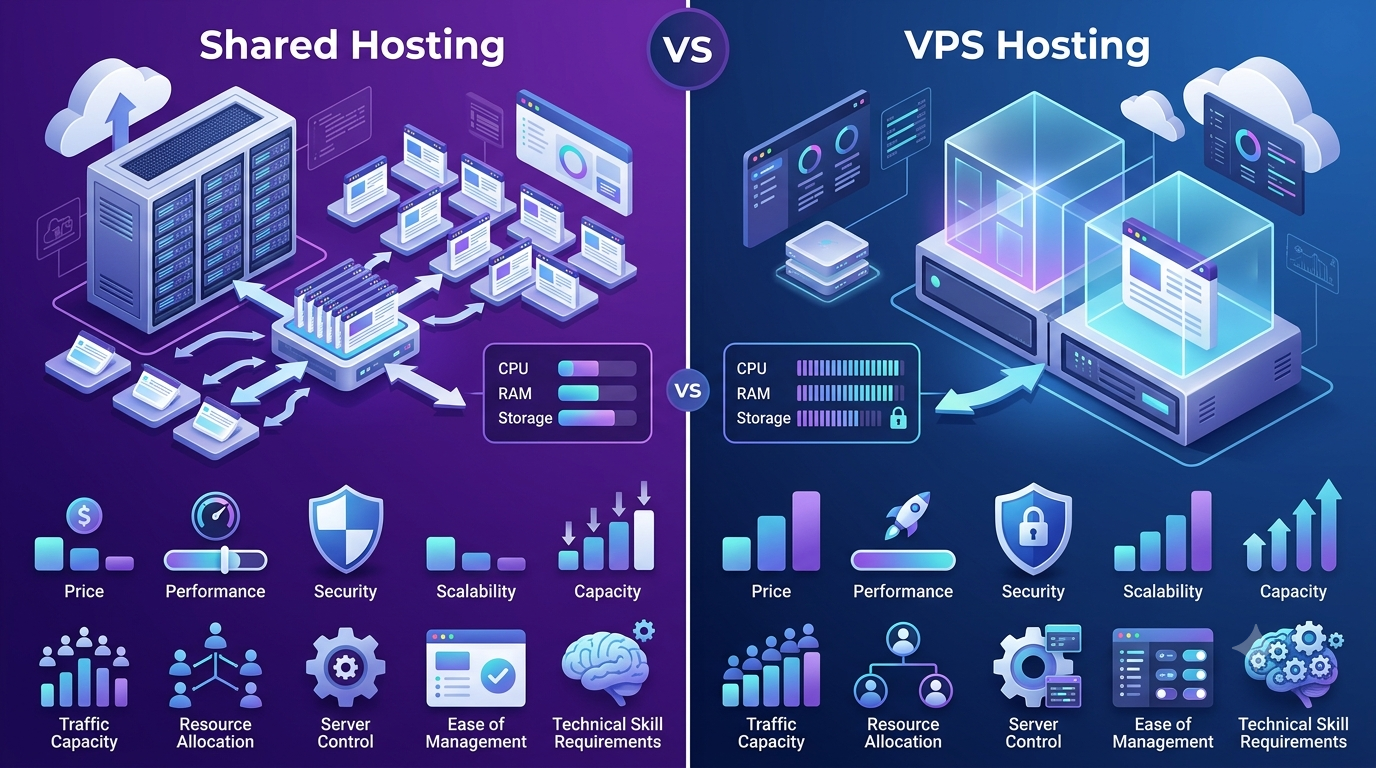
Shared hosting puts your website on a server alongside hundreds, sometimes thousands, of other websites. Everyone draws from the same pool of CPU, RAM, and storage. It’s like renting a bedroom in a large shared house: affordable, but you’re at the mercy of your roommates.
Modern shared hosting has improved a lot, though. LiteSpeed web servers, NVMe storage, and per-account resource limits have narrowed the performance gap with entry-level VPS considerably. Still, the core trade-off remains: if a neighboring site gets a traffic spike, your site can slow down too, since you’re sharing the same limited resources.
What Is VPS Hosting?
VPS stands for Virtual Private Server. You still share the same physical hardware with other users, but your portion is completely isolated through virtualization. A set amount of CPU, RAM, and storage is reserved exclusively for you. It’s closer to owning your own apartment inside a shared building: the building is shared, but your unit is entirely yours.
VPS plans also come with root access, meaning you can install custom software, configure server settings, and set up security tools like a firewall or fail2ban, none of which shared hosting typically allows. That control comes with more responsibility, though, since someone needs to manage updates and security unless you choose a managed VPS plan.
Shared vs VPS Hosting: Side-by-Side Comparison
| Factor | Shared Hosting | VPS Hosting |
|---|---|---|
| Typical price | $2–$10/mo | $7–$60/mo |
| Resources | Shared pool, fixed limits | Guaranteed, reserved for you |
| Server access | Control panel only (e.g. cPanel) | Root/admin access included |
| Custom software | Limited to host’s offerings | Install anything you need |
| Performance consistency | Can fluctuate with “noisy neighbors” | Stable, unaffected by other users |
| Technical skill needed | None — fully managed | Some, unless fully managed |
| Best for | Blogs, small sites, beginners | Growing sites, custom apps, agencies |
Figures reflect typical industry benchmarks and can vary by provider. Always confirm current pricing at checkout before purchasing.
Why Hostinger Works Well for Both Shared and VPS Hosting
Hostinger’s shared Premium plan starts around $2.69/month with NVMe storage and LiteSpeed servers, covering the needs of most new websites, blogs, and small business sites comfortably. For sites that outgrow shared resources, Hostinger’s VPS plans start at a competitive price and include full root access, dedicated resources, and templates for popular software beyond just WordPress.
Starting with a host offering both tiers has a few practical advantages:
- No full migration required when you’re ready to upgrade, just a plan change within the same account.
- Managed VPS options are available, so you get dedicated resources without needing to handle server administration yourself.
- The same support team and dashboard carry over, reducing the learning curve when you move up.
- A lower entry cost while you’re still validating your website or project.

Signs It’s Time to Upgrade From Shared to VPS
Most websites run perfectly well on shared hosting indefinitely. A few clear signals suggest it’s time to consider VPS instead:
- Consistent traffic above roughly 25,000 monthly visitors: Below this range, shared hosting on a quality provider usually holds up fine.
- You regularly hit resource limits: If your host repeatedly flags CPU or memory usage, that’s a direct sign you’ve outgrown the plan.
- You need custom server software: Applications built on Node.js, Python, or Redis typically require configuration shared hosting doesn’t allow.
- You need stronger security controls: A real web application firewall or brute-force protection like fail2ban both require VPS-level access.
- Downtime or slowdowns are becoming a business risk: If inconsistent performance is starting to cost you customers, dedicated resources are usually worth the extra cost.
People Also Ask
Is VPS hosting better than shared hosting?
VPS hosting offers more control, consistent performance, and stronger security options, but shared hosting is significantly cheaper and easier for beginners. Which one is “better” depends entirely on your site’s traffic, technical needs, and budget.
Do I need technical skills to manage a VPS?
With an unmanaged VPS, yes, you’ll need to handle server configuration, updates, and security yourself. A managed VPS plan removes most of that burden, since the provider handles maintenance while you still get dedicated resources.
How much more does VPS hosting cost than shared hosting?
Shared hosting typically runs $2 to $10 per month, while VPS plans generally start around $7 to $15 per month and scale up based on CPU, RAM, and storage. The exact gap depends heavily on the provider and plan tier.
Can I switch from shared hosting to VPS later?
Yes. Many hosts, including Hostinger, let you upgrade to a VPS plan without switching providers, which avoids the extra work of a full migration to a different company.
Is shared hosting secure enough for a small website?
For most small sites, yes, especially on a host with modern isolation technology like CloudLinux. Shared hosting does have inherent limitations, though, such as not being able to run a custom firewall, so sites handling sensitive data may want VPS-level isolation instead.
Final Verdict
If you’re just starting out or running a small to medium site, shared hosting is almost always the right call. It’s affordable, fully managed, and more than capable for the vast majority of websites. Once your traffic grows past roughly 25,000 monthly visitors, you need custom server software, or consistent performance becomes non-negotiable, VPS hosting earns its higher price. Hostinger works well either way, since its shared and VPS plans sit under one account, letting you upgrade smoothly whenever the time comes.