Cloud Hosting vs VPS for Small Business Websites
Once a small business site outgrows shared hosting, the choice usually narrows to two options: cloud hosting or VPS. Both sit a level above shared hosting in performance and control, which is exactly why the decision gets confusing. Cloud hosting vs VPS isn’t really about one being better than the other. It’s about which one matches how your traffic actually behaves.
Below, we explain how each option works, compare them on cost, scalability, and control, and help you figure out which fits your business specifically. If you’re still deciding whether you need either one yet, our guide on shared vs VPS hosting covers that earlier decision point. You’ll also find a comparison table and answers to the questions business owners ask most.
How Each One Actually Works
A VPS, or Virtual Private Server, gives you a dedicated slice of one physical server, walled off from other users through virtualization. Think of it as owning your own apartment inside a shared building: the building is shared, but your unit, your CPU, RAM, and storage, is entirely reserved for you. Resources are fixed at whatever tier you purchase, and scaling up typically means manually upgrading to a bigger plan.
Cloud hosting spreads your site across a network of interconnected servers instead of relying on one machine. If a single server has an issue, traffic automatically reroutes to another, and resources scale up or down in near real time based on demand. It’s less like an apartment and more like a plant with roots spread across an interconnected garden rather than confined to one pot.
Side-by-Side Comparison for a Small Business Site
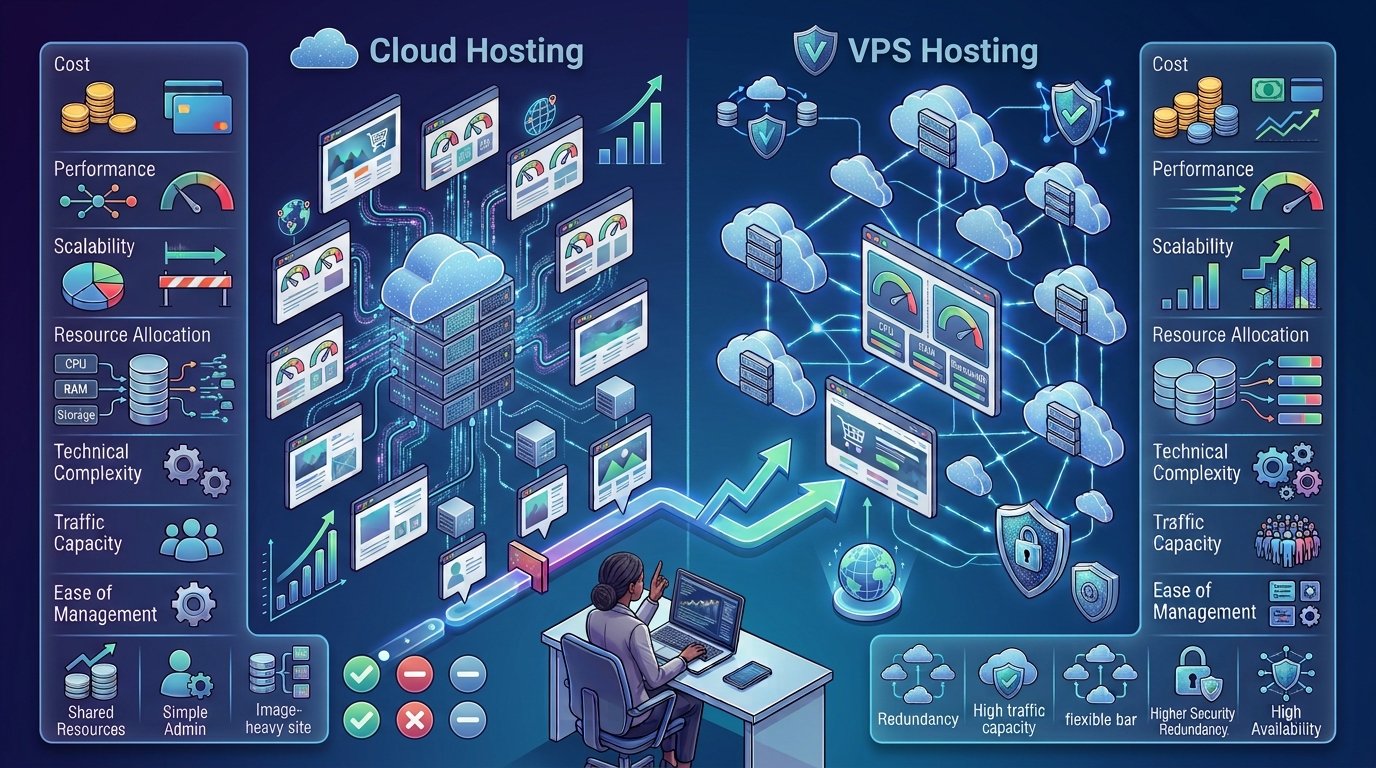
| Factor | VPS | Cloud |
|---|---|---|
| Typical price | $7–$30/mo, fixed | $10–$30+/mo, often usage-based |
| Scaling | Manual, requires a plan upgrade | Automatic, often near-instant |
| Traffic spike handling | Fixed capacity, can be strained | Built to absorb sudden surges |
| Cost predictability | Fixed monthly rate | Can vary with usage on some plans |
| Management | More hands-on, unless managed | Typically more automated |
| Best for | Steady, predictable traffic | Variable or fast-growing traffic |
Figures reflect typical 2026 industry ranges and can vary by provider. Always confirm current pricing at checkout before purchasing.

Which One Actually Fits Your Business
VPS tends to suit small businesses with predictable, steady traffic and a preference for a fixed monthly bill. If you run a local service business, a straightforward WordPress site, or an app with a consistent, known user base, a VPS often delivers the performance you need at a lower and more predictable cost than cloud hosting.
Cloud hosting makes more sense once your traffic is unpredictable or growing quickly. An online store expecting holiday rushes, a business running seasonal promotions, or a site that occasionally gets featured somewhere and sees a sudden surge, all benefit from infrastructure built to absorb that kind of spike automatically rather than falling over during your busiest moment.
It’s also worth knowing this isn’t necessarily a permanent choice. A common approach among growing businesses is starting on VPS for its cost-effectiveness, then migrating to cloud hosting once traffic patterns become less predictable. For a deeper technical explanation of how the underlying infrastructure differs, Cloudflare’s overview of cloud computing is a solid outside reference.
Don’t Overlook Security in This Decision
Security deserves real weight here, not just an afterthought. A significant share of small businesses that suffer a serious security breach close within six months of the incident, and most of those failures trace back to gaps that were addressable beforehand. Cloud hosting generally includes stronger built-in security and automated backups by default, while VPS puts more of that responsibility on you, or on your provider if you choose a managed plan. If security monitoring isn’t something you or your team can stay on top of consistently, that alone can tip the decision toward cloud or managed VPS over a fully self-managed server.
Where Hostinger Fits Into This Decision
Hostinger offers both options under one account, which removes some of the pressure from getting this decision perfect on the first try. Its VPS plans start at a competitive price with full root access and predictable fixed billing, suited to a business with steady, known traffic. Its Cloud Startup plan adds automatic scaling and 99.9% uptime for businesses expecting more variable demand.
A few practical advantages of having both available from the same provider:
- Switching from VPS to Cloud, or the other way around, doesn’t require a full site migration to a new company.
- Managed options are available on both tiers, so security and maintenance don’t have to fall entirely on you.
- The same support team and dashboard carry over regardless of which option you start with.
- Fixed, transparent pricing on VPS plans avoids the usage-based billing surprises some cloud providers are known for.
People Also Ask
Is cloud hosting better than VPS for a small business?
Not universally. Cloud hosting is better suited to variable or fast-growing traffic, while VPS often works better for small businesses with steady, predictable demand and a preference for fixed monthly pricing. Neither option is objectively superior across every use case.
Is VPS cheaper than cloud hosting?
Often, yes, especially for steady traffic levels, since VPS pricing is typically fixed regardless of usage. Cloud hosting can become more expensive on usage-based plans if traffic spikes frequently, though it can also be more cost-efficient for businesses with genuinely unpredictable demand.
Can a VPS handle sudden traffic spikes?
To a point, but resources are fixed at whatever tier you purchased, so an unusually large spike can strain performance. Cloud hosting is specifically built to absorb sudden surges automatically, which is one of its main advantages over VPS in this scenario.
Do I need technical skills to manage either option?
An unmanaged VPS requires real server administration knowledge, while cloud hosting is typically more automated out of the box. Both options offer managed plans, though, which shift most of that technical burden onto the provider instead of you.
Can I switch between VPS and cloud hosting later?
Yes, and it’s a common path for growing businesses: start on VPS for its predictable cost, then move to cloud hosting once traffic becomes less predictable. Providers offering both options under one account, like Hostinger, make this transition easier than migrating to an entirely new host.
Final Verdict
For a small business with steady, predictable traffic, VPS usually offers the better balance of cost and performance. Once your traffic becomes variable, seasonal, or fast-growing, cloud hosting earns its price with automatic scaling and stronger built-in resilience. Hostinger supports both under one account, so whichever you start with, moving to the other later doesn’t mean rebuilding your site from scratch. Whichever you choose, weigh security and management responsibility as heavily as price, since that’s often the factor that determines how smooth the experience actually is day to day.